The Holocaust by bullets, shootings in Ukraine - M Holocaust Memorial

- Presentation of the exhibition
- Jews in Ukraine
- The beginning of the genocidal policy
- The radicalization of genocide
- Father Patrick Desbois and Yahad-In Unum
- The stages of execution
- Panoramic views of the exhibition
The stages of execution
The hundreds of testimonies collected by Yahad-In unum and archival documents provide a better understanding of the sequence of murders perpetrated during the Holocaust. The organization of killings, if it includes variants according to the places, the importance of the cities or villages concerned, follows a similar process and methods in all the regions where Yahad-In Unum has conducted its investigation until today.
The exhibition of the Shoah Memorial meticulously describes the 8 stages highlighted by the researchers of Yahad-In Unum. The trail thus presents texts and archival documents as well as excerpts from testimonies, montages of excerpts from the stories of Ukrainian witnesses interviewed by the Yahad-In Unum team.
1 - The Germans organize the preparations for the killings:
Jews are summoned by display, radio or loudspeakers; Ukrainians are requisitioned.
The Germans ordered the Jews to gather in a specific place, equipped with warm clothes and food for several days. In small towns or villages, they contact the mayor of the village who provides them with the list of inhabitants and then only have to go to the home of their victims to arrest them.
The requisitioning of Ukrainian civilians by the Germans is a common and frequent occurrence in the towns and villages of Ukraine. Peasants, men and women, often very young, are requisitioned to dig pits, transport Jews, fill the pits.
2 - The Jews are arrested, gathered or locked up, then taken to the place of execution.
Several methods are used to arrest Jews: the ruse by announcing their transfer to the East, in Kiev, or in Palestine; the grouping in ghettos; arrests at home.
The police spent several days crisscrossing the village, fields and forests to find the Jews who were hiding in their attempt to escape the arrests.
In all cases, arrests are accompanied by numerous murders.
The Jewish victims are first transported from the place of assembly to the place of the first undressing close to that of execution, either on foot, arranged in columns, or on horse carts accompanied by armed guards, or in trucks that also carry an armed guard.
3- The Jews wait near the place of execution, then they are stripped and their last possessions confiscated. A final selection takes place.
The waiting area is not located next to the pit so that the victims cannot see it. Sometimes the Jewish victims do not wait but are instead led very quickly and under blows, to be shot as soon as they approach the pits.
In the majority of cases, Jews must undress completely, first removing their warm clothes, which will be deposited in heaps or in boxes previously arranged, then, further on, they remove their other clothes. Jews who refuse are often killed on the spot.
4- The shooting Kommando is set up, the victims are placed at the edge of the pit. The execution order is given.
Most of the time, Jews are executed with a single bullet fired from the back, contrary to the German practice of military executions. This choice, explicitly mentioned by Paul Blobel himself, seems to have been made from the very beginning of the shootings. For the rest, the commandos gradually reduced their methods of killing, after many and sordid debates. Following a "liquidation" he attended in Minsk, around 15 August 1941, Himmler asked that other methods of assassination be tested. The choice went to gas vans.
5- After the shooting, the pits are filled in.
In exceptional cases, victims receive the coup de grace. In some regions, cremation of bodies is carried out.
After the shooting, the pit was filled with lime and then earth. These are often the local populations
requisitioned, with their equipment, who must carry out the filling work and who therefore bear witness to the fact that many victims are still alive at that time.
6- The Germans are having a party in the village.
Jewish clothing and goods are sorted, taken away, distributed or sold.
7 – Some Jews manage to survive.
Yahad’s team has found and interviewed some of these survivors who sometimes live only a few kilometers from the place where they escaped death.
8- The extermination site of Babi Yar in Ukraine.
When German troops invaded Kiev on 19 September 1941, nearly 100,000 Jews fled the city. Accused of having prepared attacks and caused fires, the Jews who remained in Kiev were invited by a notice to gather at 8 a.m. on 29 September 1941 in order to be "resettled" elsewhere. They were then supervised up to the ravine of Babi Yar, northwest of the city where they were assassinated in small groups on 29 and 30 September 1941. The report of Einsatzgruppe C at its headquarters states 33,771 Jewish victims.

Hanna Antonivna Gonovalchiouk. Born in 1921. Interviewed in Berditchev, Zhitomir region on 16 October 2005. Direct witness. Witness 251.
© Guillaume Ribot
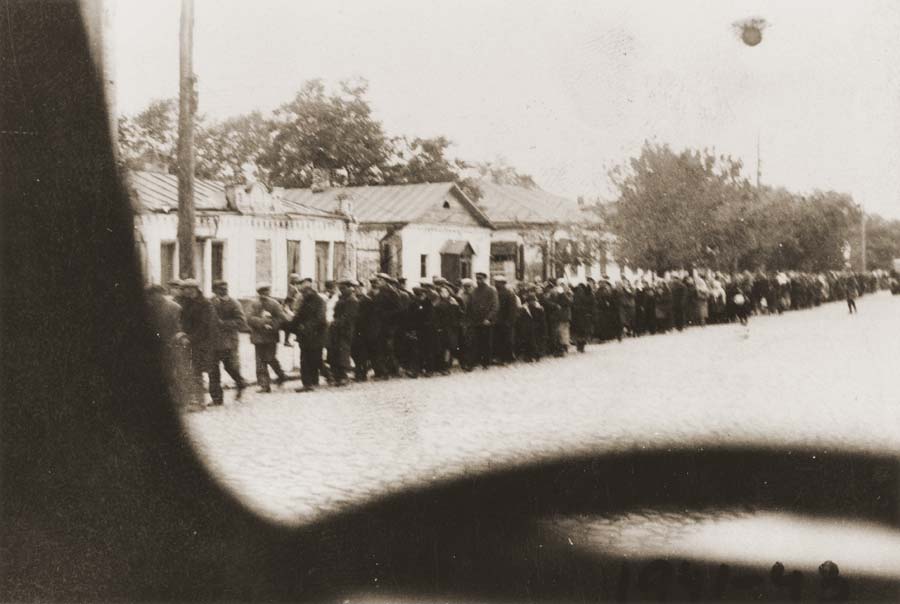
Columns of Jews led into the custody of German soldiers in the streets of Kamenetz-Podolsk, Ukraine, to an execution site outside the city. 27 August 1941. Kamenetz-Podolsk, Ukraine.
© USHMM, courtesy of Ivan Sved

Jewish prisoners are forced to undress before their execution by Ukrainian auxiliaries. Photographer unknown. 1942. Chernigov, Ukraine.
© USHMM, courtesy of Magyar Nemzeti muzeum Torteneti Fenykeptar
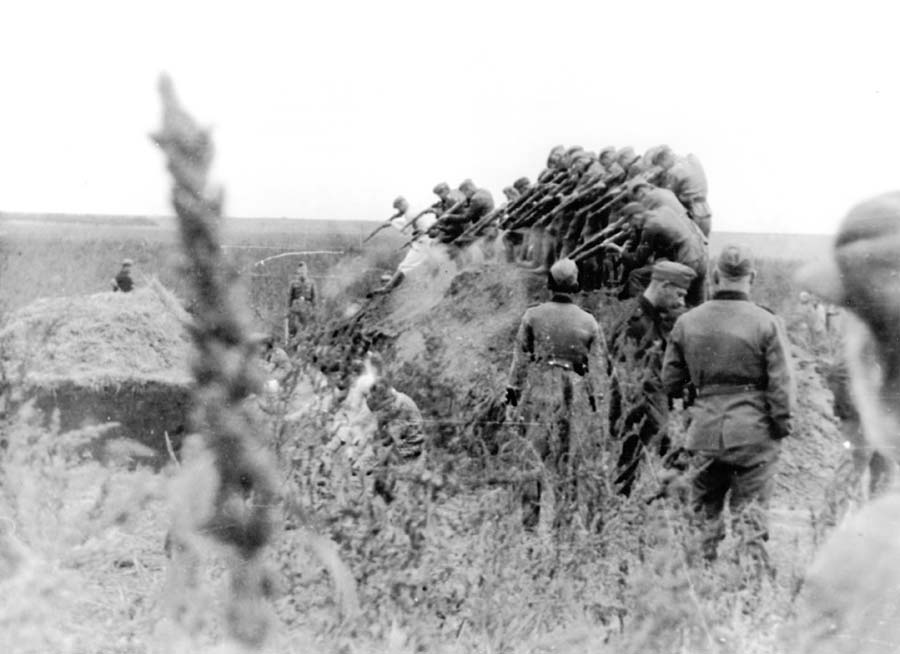
Members of an Einsatzkommando firing at Jews in a field in Dubossary, Moldova. 14 September 1941. Dubossary, Moldova, USSR. Unidentified photographer.
© USHMM, Impérial War Museum. Crown copyright. Rights reserved.

Nina Roufimovna Lisitsina. Born in 1939. Interviewed in Belogorsk, Crimea on December 24, 2004. Survivors. Witness 103.
© Guillaume Ribot