June 18, 1940, the appeal of General de Gaulle
Excerpt from General de Gaulle’s appeal
On 18 June 1940, General de Gaulle, then Brigadier-General and former Secretary of State for War and National Defense, the sole French political leader in London, made an appeal to the soldiers on the BBC airwaves, engineers and technicians to join him in continuing the fight against Germany: “should hope disappear? Is defeat definitive? No! [...] This war has not been decided by the Battle of France. This war is a world war [...] Whatever happens, the flame of the French resistance must not and will not be extinguished.”
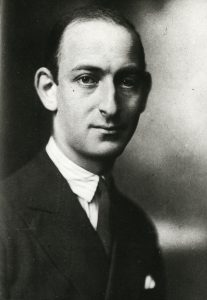
For some, escaping the Nazi occupier is both an act of refusal and an act of survival. Raymond Aron (1905-1983), a young Jewish philosopher, left his detachment in Bordeaux and embarked at Saint Jean de Luz. He later said that he heard the announcement of the armistice in the boat which took him to England, where he would join General de Gaulle.
Raymond Aron
Portrait of Raymond Aron, 1940s
On the same boat, it is also a coincidence that René Cassin (1887-1976), a French jurist of Jewish origin, represented France at the League of Nations until 1938, when he resigned after the Munich Agreement. He immediately put himself at the service of General de Gaulle’s Free France.
“Jurist of Free France”, René Cassin is the first to think in February 1943 about the agreement between the resistants of the interior and those of Free France which will give rise to the Council of the Resistance. René Cassin is also, in 1948, one of the authors of the Universal Declaration of Human Rights.
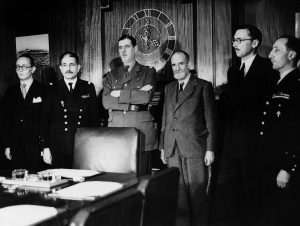
René Cassin
The French National Committee of Free France in exile in London. England, 31/10/1941
From left to right: André Diethelm, Vice-Admiral Emile Muselier, General de Gaulle, René Cassin, René Pleven and Admiral Philippe Auboyneau