Tools for teaching
The Shoah Memorial has gathered and selected resources of various kinds for teachers and educators wishing to introduce young people to the history of the Holocaust or to deepen with their students a particular aspect of the period encompassing the Second World War world and the enterprise of persecution and destruction of the Jews of Europe.
RECOMMENDATIONS FOR THE STUDY OF THE SHOAH BY THE IHRA
In response to the growing lack of awareness about the Holocaust among young people, the IRHA (International Holocaust Remembrance Alliance) has developed recommendations that provide guidance for education policy-makers, school principals, and teachers. so that the transmission of this dark period of history continues.
The Shoah Memorial has been part of the IRHA since 2001.
In order to accompany these actions, the IRHA published a document of recommendations for the teaching and study of the Holocaust. Very complete, this document includes the following points:
- Why teach the Shoah?
- What should be taught about the Holocaust?
- How to teach the Shoah?
- List of main terms
- The Stockholm Declaration and IHRA working definitions
Download the document
Online resources
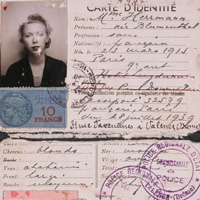 Like other history objects studied in class, the Holocaust must be addressed through archival documents allowing students to develop historical reasoning under the guidance of their teachers. The corpus retained in these "pedagogical tools" is deliberately reduced; it is an indication of the type of available sources, which are counted by thousands.
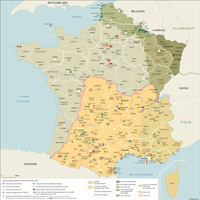 The downloadable maps illustrate different themes: the internment camps in France, France in 1940, Europe in 1942, the ghettos in Poland, the routes of the main convoys to Auschwitz, the concentration camp universe, the death marches.
 The audiovisual resources are a particularly suitable medium for testimony. In addition to many quality stories, this part of the "toolkit" includes recordings of meetings and conferences.
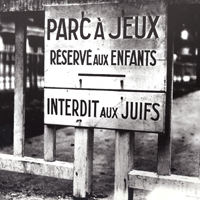 Historical summaries are grouped together in the section thematic sheets. They cover most of the themes of the history of the Shoah: the rise of Nazism, the major stages of the Holocaust in Europe, the Vichy regime and the Jews, the trials of Nazi criminals. Themultimedia encyclopedia of the Shoah is a good complement to these sheets.
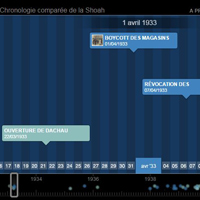 Finally, the comparative chronology of the Shoah, inseparable from the march to war and the different phases of the world conflict of 1939-1945, is a valuable tool for better understanding the history of the destruction of European Jews. La chronological timeline of the Shoah illustrée is also a good complement.
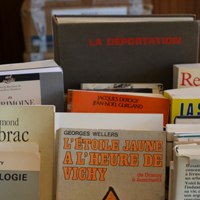 A selective bibliography, a filmography and a selection of websites complete these resources for the teacher.
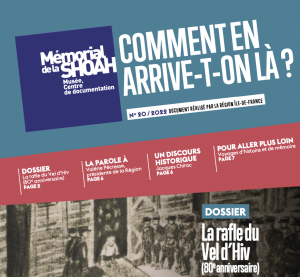 Online flipbook for high school students, produced by the Île-de-France region and the Shoah Memorial “How did we get here?”
Borrowing an exhibition
For many years, the Shoah Memorial has developed awareness-raising activities aimed at both school audiences and the general public to understanding the history of the genocide of the Jews during the Second World War. He thus designs and produces travelling exhibitions intended to circulate in France and abroad.
These exhibitions present often previously unpublished archives (iconographic documents, letters, testimonies...) which illustrate concise texts supervised by European specialists in these fields. maps and lexicons facilitate the understanding of the themes presented. These exhibitions are made available to schools (middle and high schools) that request them.
DISCOVER
Booklets to help you visit a traveling exhibition
Educational support booklets for travelling exhibitions are available. In accordance with the programs of the National Education, they were carried out to facilitate the work of teachers and allow students to observe, question and understand the documents on the panels of the exhibitions.
Booklets to help you prepare an educational workshop
Thematic booklets specific to certain workshops offered at the Memorial allow teachers to discuss the topics of the workshop, in advance, with their students.
Thematic brochures
If the history of the Shoah is part of the school curriculum and is mentioned at ESPE and in textbooks, it nevertheless remains a difficult historical subject to address with younger generations. The pedagogical service provides teachers and librarians with six thematic educational brochures:
- Auschwitz
- The trials of Nazi criminals
- The ghettos The "Final Solution"
- What did we know about the Holocaust?
- Nazi Germany and the Jews
documentation center and multimedia teaching center
The Shoah Memorial is the first information and documentation center on the history of the Holocaust in Europe. It has more than 40 million pages of archives, 280,000 photographs, 5,000 postcards, 4,000 posters and 80,000 books, periodicals and library documents that can be consulted on site, mainly at the Paris site, but also at the Drancy site. The Shoah Memorial in Paris also has a multimedia teaching centre for listening to and viewing audiovisual documents.
bookstore
First bookstore in France on the subject, the Mémorial de la Shoah bookstore offers more than 10,000 references. An up-to-date and comprehensive offer covering the entire spectrum of publishing: scientific works (history, philosophy, psychology, etc.), testimonies, essays, biographies, popular or awareness-raising books, fiction and children’s books.
internet
Other resources for teachers are also available on:
- enseigner-histoire-shoah.org: A website, developed with the Ministry of National Education, to help teachers teach the history of the genocide of the Jews during the Second World War. It includes news, proposals for activities to be carried out in the classroom or in schools, and practical information on organizing visits to places of remembrance in France and Europe.
- cnrd.memorialdelashoah.org: Every year, the Shoah Memorial creates a website dedicated to the theme of the CNRD. In order to provide the keys to understanding the subject and support students and teachers in their reflection, this site offers many online resources, bibliography, videos, glossaries, chronologies, etc...
- grenierdesarah.org: As an introduction to the history of the Holocaust, this site is aimed at children aged 8 to 12 years with due regard for their sensitivity. It gives to see and hear tales and expressions that show the diversity of Jewish cultures transmitted before, during and after the Second World War. It offers nine courses that bear witness to the daily lives of Jews during the war, based on archival documents and suggestions for activities, to be used in the teaching area dedicated to teachers.