The Jews of France in the Shoah
From 1933 to 1945, the Nazi ideology mobilized German society, its administration and army, made up of doctors, lawyers, intellectuals, artists, trade unionists, as well as its industry and economic resources, first to exclude, then to eradicate from the face of the earth, physically and culturally, all Europeans born Jews.
The help of other governments and local administrations that provided the framework and logistics, and sometimes even more so, the indifference of the majority of European populations, at least for a while, contributed to the scale and effectiveness of the crime.
A singular, archaic and modern genocide in twentieth-century Europe, as evidenced by the different phases of this mass crime that began first in the ghettos of Poland, which continued with the mass shootings in Ukraine, then became widespread in the extermination centers of Upper Silesia.
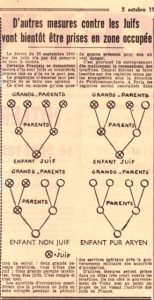
"Vichy promulgated the status of Jews in France," articles from the anti-Semitic and collaborationist press, October 19, 1940. © Shoah Memorial
Between 1940 and 1944, the Jews of France were also hit hard by anti-Semitic legislation, French and German, by internment then deportation. They suffer exclusion from a society in which they thought they were integrated and by which they believed they were protected. During the summer of 1942, the Vichy government delivered to the German occupiers children under sixteen years old, as well as 10,000 foreign Jews from the southern zone rounded up in a part of the territory under French administration.
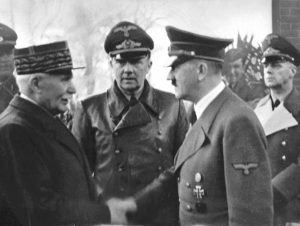
Marshal Philippe Pétain is welcomed by Adolf Hitler at the station of Montoire-sur-le-Loir. Loir-et-Cher, October 24, 1940. © Shoah Memorial
In this struggle for life, the behavior of the Jewish population is decisive. After a period of illusions, according to the expression of the historian Georges Wellers, the Jews of France take their destiny in hand, and decide to switch totally or partly into clandestinity, individually or through the Jewish rescue networks. As they sought to escape the Vichy police and the German occupation troops, their determination was relayed and supported by many French people who were moved by the dramatic scenes they witnessed during the mass arrests of summer 1942.
Nevertheless, 76,000 Jews, including more than 11,000 children, were deported by the Nazis with the help of the Vichy government and snatched from life. 25% of the Jewish population in France is a victim of the Shoah.
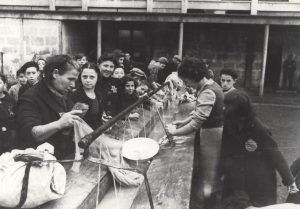
Jewish internees, Drancy camp (Seine-Saint-Denis). France, 12/1942. © Shoah Memorial
After years of amnesia, Jacques Chirac, the President of the Republic, finally recognized in July 1995 the responsibility of the French state in the persecution and deportation of Jews from France. This declaration made possible the passage from memory to history and the integration of this history into that of France, in all its complexity, both that of collaboration and that of the Righteous who helped save three-quarters of the Jews living in France.
This story is close to us, it took place in our country, in our towns and villages, then tragically continued in the killing centers erected by the Nazis in Poland, in the heart of Europe. It’s up to all of us to appropriate it, to live and build with this crime, and despite this crime. It is also up to all of us to use the history of the Shoah, without distorting it, without trivializing it, without instrumentalizing it, in order to question our present and preserve the future of our freedoms.
Discover the history of the Jews during the Second World War in Europe and more precisely in France in the permanent exhibition of the Shoah Memorial in Paris on nearly 1000 m2. Visit also the Shoah Memorial of Drancy which retraces all the history of this major camp of the persecution of the Jews of France.
to read
 The Jews of France in the Shoah, from Jacques Fredj, Shoah Memorial, 2011.
Catalogue of the permanent exhibition at the Shoah Memorial.
ORDER