Cultural programming as part of the 80th anniversary of the "Billet vert" roundup
On the occasion of the commemoration of the "Billet vert" roundup of May 14, 1941,
the Shoah Memorial offers you a varied program
From Friday, May 14, 2021 until Friday, May 21, 2021
Screening on the website of Jean Barat’s film "I will return"
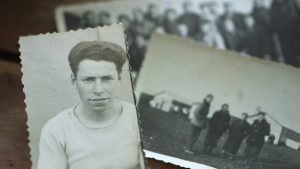
Je reviendrai by Jean Barat, 2015, France, 1h07, documentary, produced by J.W Production – Jacques Ferrara & Injam Production – Marc Andréani.
Synopsis: In May 1941, 28-year-old Zysman Pin is arrested in Paris by the French police for being a Jew and interned at the Pithiviers camp. On 25 June 1942, he was deported to Auschwitz. 70 years later, he tells how he managed to survive four years of internment and deportation. This documentary focuses on the conditions of this survival and on the perspective of a 100-year-old man who looks back at his destiny and that of his family, leading him to live one of the greatest tragedies of humanity.
With the participation of the Centre National du Cinéma et de l'image animée and the support of the Fondation pour la Mémoire de la Shoah.
Historical advisor: Annette Wieviorka
Voiced by: Carlo Brandt
Music by Jean-Noël Yven
A few words from the director, Jean Barat:
projection of the film "La terre ne ment pas" by Philippe Claire
Documentaire, France, 2009, 74 min, Prospective image, with the support of the Fondation pour la Mémoire de la Shoah.
Synopsis: the documentary, whose title refers to a speech by Marshal Pétain, looks back at the fate of foreign Jews, arrested as part of the "Billet vert" (Green Note) roundup, transferred to the camps of Beaune-la-Rolande and Pithiviers, then sent to farms in Sologne.
Emile Frajerman, who managed to escape from the farm of La Matelotte, thus escaping the internment at Drancy and then the deportation to Auschwitz that struck the other internees, reveals to us what was his daily life and that of his companions in misfortune. His voice mingles with the comments of the historian Benoît Verny, the testimonies of inhabitants of the surrounding countryside as well as that of Christian Spie who, newly arrived in the region, undertook to collect the memorial traces of an episode forgotten by many.
In addition to his documentary, Philippe Claire wrote the book Une autre rafle, les kommandos de Sologne, published by CPE in 2016.
Friday, May 14, 2021, from 7 p.m.
Online conference – 80 years ago, the greenback roundup ...
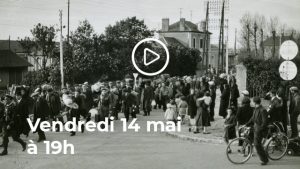
A few months ago, nearly 80 years after the events, collectors made a major discovery: 98 totally unknown photos of the roundup known as the "billet vert", the first mass arrest of foreign Jews in Paris on 14 and 15 May 1941.
These exceptional iconographic documents are made up of five photographic films, taken by the German propaganda services, attesting to scenes that we only knew until now through the testimonies of the survivors or families of those arrested. They show the journey of these men from the Japy gymnasium to the farewell to families, from boarding buses for the Austerlitz station until their arrival at the Pithiviers camp. In addition to these photos, there is the discovery of a mini filmed report. How did the teams work to find the author of these images and authenticate them? What light do these new elements shed on the question of the final solution in France and how important is the discovery of these new images 80 years after these events?
This exceptional collection has now joined the collections of the Shoah Memorial.
By Lior Lalieu-Smadja, head of the photo library at the Mémorial de la Shoah Paris and Catherine Thion, PhD in history.
Follow the live conference on the CERCIL website
Sunday, May 16, 2021, at 4 p.m.
Drancy’s meetings: The internment camps of Loiret by Catherine Thion
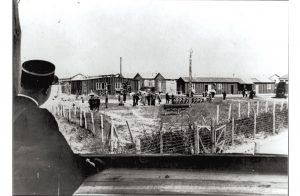
Gendarme supervising the Beaune-la-Rolande camp, 17 May 1941.
© Shoah Memorial.
Free meeting, registration required
SIGN UP FOR ZOOM
Live on the Shoah Memorial website, Facebook, YouTube and Zoom
80 years ago, on May 14, 1941, about 3,700 foreign Jewish men arrested in Paris and its suburbs were transferred to two camps in Loiret. This is the first mass arrest in an occupied zone. It was also the beginning of internment in the camps of Pithiviers and Beaune-la-Rolande. These men remained there, for the majority of them, for more than a year before being deported to Auschwitz in June and July 1942. From 19 July 1942, it was the families arrested during the roundup of the Vél’d'Hiv’ who were locked up there for a few days, only a few weeks before being deported. Many other Jews will still be interned there, until the end of September 1942 in Pithiviers, until the summer of 1943 in Beaune-la-Rolande.
Thursday, May 20, 2021, 7:30 p.m.
ONLINE MEETING ON THE INTERNET Green ticket roundup: discovery of 98 previously unpublished photos
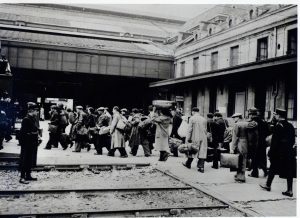
The arrested Jews were escorted by French gendarmes and German authorities to the Gare d'Austerlitz to be interned in the camps of Loiret, Pithiviers and Beaune-la-Rolande, 14 May 1941.
© Shoah Memorial.
Free event
Live on the website of the Shoah Memorial, Facebook and YouTube
All the new photos will be screened at the Shoah Memorial and a selection will be visible at the Japy gymnasium.
A few months ago, nearly 80 years after the events, collectors made a major discovery: 98 totally unknown photos of the roundup known as the "billet vert", the first mass arrest of foreign Jews in Paris on 14 and 15 May 1941. These exceptional iconographic documents are made up of five photographic films, taken by the German propaganda services, attesting to scenes that we only knew until now through the testimonies of survivors or families: men at the Japy gymnasium at the farewell to families, from boarding buses for Austerlitz station, until arrival at the Pithiviers camp. This exceptional collection has now joined the collections of the Shoah Memorial.
With Serge Klarsfeld, historian, president of the association of the sons and daughters of Jewish deportees from France, Lior Lalieu-Smadja, responsible for the photo library of the Shoah Memorial, and Liliane Rysfeld, witness to her father’s departure on 14 May 1941.
Moderated by Ilsen About, researcher at the CNRS, member of IRIS, CNRS-EHESS.
They talk about it:
The photographer’s eye
Loopsider
Period studio
Le Monde
Paris Match