Questions to David Teboul,
curator of the exhibitionas part of the exhibition "Simone Veil. My sisters and I"
Tuesday, February 10, 2026 Thursday, October 15, 2026
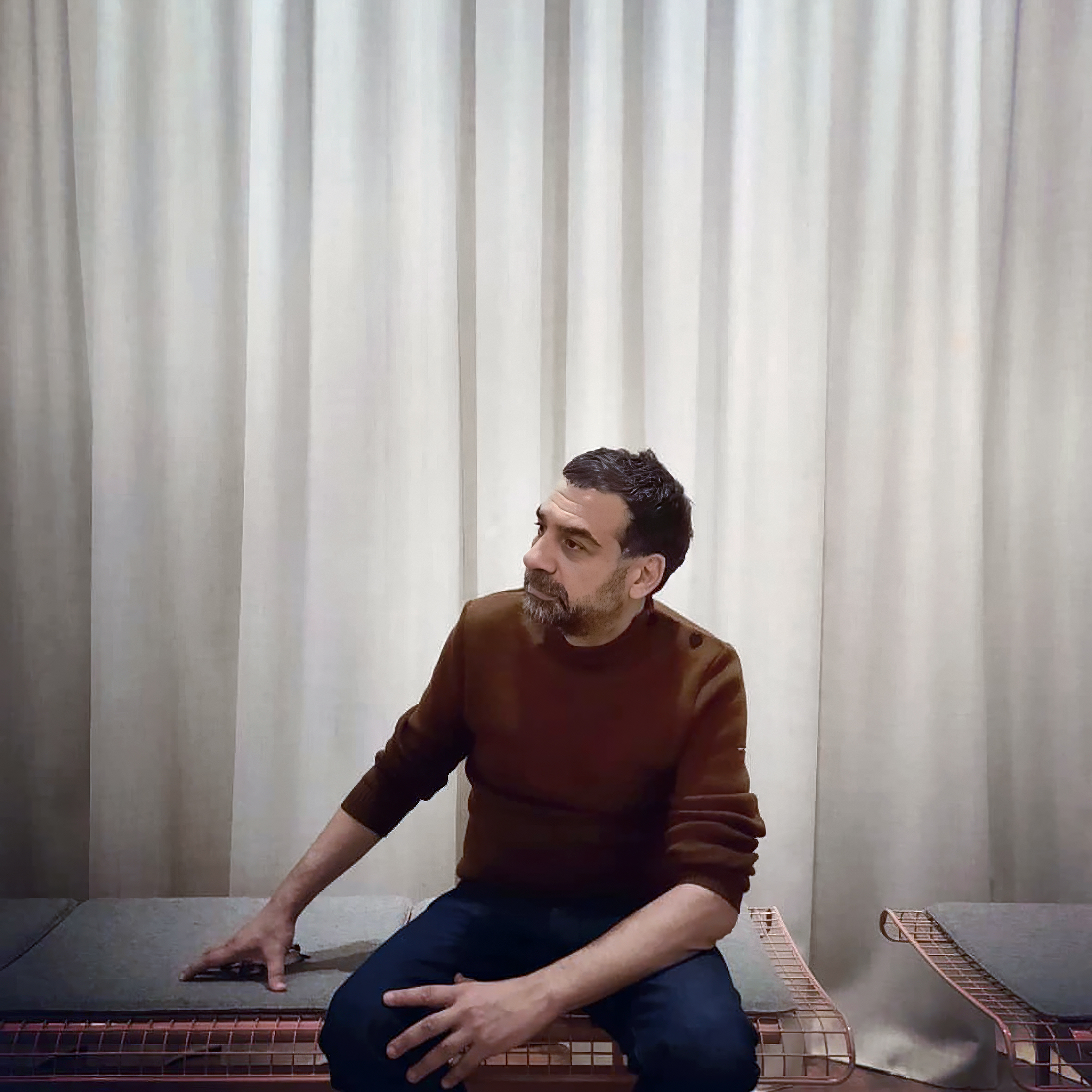
The filmmaker, artist and author David Teboul met Simone Veil in 2003. From then on, a link was created through an uninterrupted dialogue that allowed memory – sometimes painful – to emerge.
Excerpts from an interview between Mathieu Lericq and David Teboul, present in the book Simone Veil, mes sœurs et moi.
Mathieu Lericq: In the book Simone Veil. L'aube à Birkenau (2020), built from textual and photographic archives, it is about the moment when you saw Simone Veil for the first time on television, at the end of the 1970s. In what way is this episode foundational for you and does it announce the real encounter that will take place at the beginning of the 2000s?
© Laurent Goumarre
David Teboul : The first time I saw Simone Veil on television, I was ten years old. It was a debate as part of the show Screen Folders, at the end of an episode of the series Holocaust. (...) This series features a German Jewish family between 1935 and 1945. This family could be the Jacob family. It’s a very mediocre but also upsetting TV movie. I have never cried so much in front of a television program, I think. All of France was upset. (...) At the end of the third episode of the series, Screen Folders were on the theme "Life and death in Nazi camps". Simone Veil participated in the debate. It contains all the symptoms of the time regarding the biases through which these events were treated. During the debate, a conflict emerged over the differences between the deportations of Jews and the deportations of resistance fighters. Marie-Claude Vaillant-Couturier represented the resistant deportees. Simone Veil impressed me. At first, I found her very beautiful. But above all, the words she used moved me. At the time, we never talked about intimacy. A political leader did not talk about his private life. Simone Veil spoke of his life in Nice. It stuck with the landscape at the time. She said that relations between the inmates were really more difficult than what the series shows. She reproached him for being honeyed. It deeply troubled me. His face. His bun. His words disrupted the perception I had of the series.
M. L.: Who is this exhibition for? Was it designed for a particular audience?
D. T.: Intimately, I would like teenagers to be able to enter this family and identify with its members by following their path. I would like all audiences to feel concerned, including young audiences. For the older audience, the exhibition immerses them in their youth. A whole section of the exhibition refers to the youth of the Jacob sisters. Simone Veil is nineteen years old when she returns from the camps. She was eighteen in deportation. It is an exhibition about young people who were broken by the war. It is interesting to see how eighty-year-old women look back on their broken youth.
Mr. L. : Did meeting Simone Veil mean dealing with the Shoah in a particular way? What has been so important in this relationship, to the point of making memory the central subject of your works?
D. T.: (...) my idea was very early to integrate the Jacob family into the national novel. I found it interesting to approach history through the trajectory of this French family, born from a penniless bourgeoisie, which was marked by World War I and scouting in the 1930s, and who later suffered deportation and camps due to Nazi Germany and Vichy. Les Jacob represented the itinerary of French Jews whose history breaks with current revisionisms. This family was not protected by the Vichy regime, even though it was patriotic and assimilated. I understood that this family, all of its members, could enter the Pantheon. In this family, there are very different personalities. Yvonne does not look like her husband. They do not quite share the same opinions. She is more sensitive to the ideas of Léon Blum’s Popular Front. He was more conservative, more resistant to reconciliation with Germany. What interests me, not being a historian, are the fictions and what emerges from reality. The fictional. I became interested in their youth, in the chronicle of daily life. How intimacy and history meet. Later, I became interested in how to rebuild oneself. What it means to tell this story that is both tragic and unusual: pre-war France, wartime France, and post-war France. In the third period, we can see a distinction of status between former deportees, depending on whether they were resistance fighters or Jewish deportees. As I am very interested in small things to consider big things, I have inventoried the most minimal aspects, especially about life in Nice.
M. L.: What unpublished documents does the exhibition allow us to discover?
D. T.: The exhibition makes the public discover many unpublished elements, concerning Denise Vernay for example. Stories written just after his deportation to Ravensbrück, which contain a testimony of his life in the camp. These are texts in the first person. There are also other texts written later, where she returns to the experience of the deportation of resistance fighters, which allow us to better understand her life. Poems are also made public, written on the return from the camp; they concern the life before, his mother disappeared. There is also correspondence with her sister Simone, letters from Denise at the end of her life concerning their inability to discuss their respective deportations. The feeling of exclusion expressed by Denise is a major issue. She speaks of a "double duo," all the more painful because it refers to Milou’s death. These are late letters, dating from 1987-1989. The sisters come back to the difficulty of talking about the past. They talk a lot about silence, about what separated them, namely the camp. They also evoke the difficulty of mourning Milou.
Back to the exhibition page «Simone Veil. Mes sœurs et moi»