Tribute to Hubert Heilbronn, former Vice-President of the Shoah Memorial, who died on 14 April 2024
The Shoah Memorial pays tribute to Hubert Heilbronn (1931-2024), its former vice-president and administrator.
Hubert Heilbronn has accompanied and supported the development of our institution for many years.
He was commander of the Legion of Honor and commander of the Arts and Letters.
The Shoah Memorial offers its condolences to his family and loved ones.
Tribute to Hubert Heilbronn
Former Vice-President of the Shoah Memorial, from 1985 to 2008,
by his son François Heilbronn
at the Montparnasse cemetery, on April 17, 2024
Dear family, dear friends and very dear friends of Hubert Heilbronn
Thank you for coming in such large numbers today to accompany our dear father, Hubert Heilbronn.
We are here with him, he is with us, for one last time.
This tricolor flag, so dear and cherished by him and by our whole family, envelops it. The flag of France, of the French Republic, its France and the France of the patriots in her family who fought for her, and for so many of them to the point of supreme sacrifice.
On his coffin is engraved a Star of David, on the flag are placed his two decorations and among the most illustrious, that of Commander of the Legion of Honor whose motto suits him so well, Honor and Fatherland. And that of Commander of the Arts and Letters for him, the eternal lover of books.
Honneur et Patrie, decorated with the Legion of Honor like his father Jacques Heilbronn, who was 18 years old in a military capacity for heroic acts in 1918, his grandfather Henri Klotz, an artillery captain at Verdun, and an officer of the Legion of Honor in a military capacity, his great-grandfathers Victor Klotz and Julien Hayem, both officers of the Legion of Honor and valiant national guards during the siege of Paris in 1870. From his great-great-grandfather Simon Hayem, also an officer in this order.
And our father, who was so attached to this honor and to our homeland, was delighted when in the sixth generation, and thus without interruption, my sister Anne, the first woman in our family for 150 years, and I were in turn named Knights of the Legion of Honour.
So many heroes in his family. Two of his great-uncles fell for France in 1914 and 1915, Captain Émile Hayem and Lieutenant Henri Hayem. Other heroes, whom he loved and knew fell in battle between 40 and 44: his uncle Lieutenant Pierre Heilbronn in June 40, his other uncle Parachute Lieutenant François Klotz in June 44, and his cousin Hubert de la Fressange in October 1944.
He always admired his big brother Didier Heilbronn who at 17 years old joined Algeria and the Parachute Shock Battalion, was wounded and decorated in the fighting of the Vosges and Germany at 18 years old.
Papa served for three years as Marshal of the Logis at 2th and at 3th Hussard, and the books cluttered the turret of his tank in the winter of '55 in the Atlas Mountains.
Today he joins his heroic dead who carried so high "France by falling down".
There is also his fidelity to his Jewish identity, to his inseparable Jewish and republican values. It belongs to these Jewish families that we used to call French Israelites and that my grandfather, always full of humor like my father, nicknamed PIF ... French Israeli patriots.
On the paternal side, Heilbronn was a family from Fürth in Bavaria whose grandfather Jules chose France in 1852, land of freedom and hope. On her mother’s side, her mother Anne-Marie Klotz comes from a Jewish Alsatian family in Wissembourg and by her mother Flore Hayem from a Jewish Lorraine family in Metz since the 16thth century. These two families settled in Paris between 1810 and 1820. He was proud to be able to say that he had been born in Paris into a Parisian family for at least five generations.
The Hayems were descended from Doctor Isaïe Cerf Oulman, savior of King Louis XV, and the Spire-Lévy, descendants of the first Lévy rabbis of Metz. These came directly from Mattathias de Trèves, Chief Rabbi of France, at the 14thth century and finally of the greatest Talmudist and first prose writer in the French language at 11th century in Champagne, the rabbi and winemaker Rachi de Troyes.
This spiritual family of rabbis and great scholars over at least eight centuries, also represented its identity, its heritage and surely its passion for the Books; it was secular, deeply secular and absolutely not practicing except for the Yom Kippur fast.
Then he met Rabbi Delphine Horvilleur, more than twelve years ago during the Bar Mitsvot of his grandchildren David, Max and Salomé. She took him up to the Teva to bless them, and where for the first time as on that day his Hebraic names were pronounced, Israel ben Yaacov, Israel son of Jacob.
With Delphine, he found in her, beyond her intellectual and spiritual qualities and their shared love for Jewish jokes, the strength of Lorrain Judaism filled with love for France, the Book and all books. I thank her for her words today. He had expressly requested that Delphine accompany him, as she did so well in October 2019 for our mother, right here under this linden tree.
Parisian child of the Republic and public schools, his Jewish identity was secondary, even forgotten. But on October 3, 1940, the French State, all the very high French Administration including the Council of State, wrote to this young 9-year-old boy, you are now a pariah, a less than nothing, an excluded from the Nation.
He gradually became an invisible child, going from cache to cache, out of school, hunted, tracked down like 70,000 other Jewish children in France. Hunted by the police and gendarmerie of his country France and by the Gestapo.
His head for four years was priced.
He will leave Paris in June 1940 with his dear grandparents Ernest and Claire Heilbronn. He will go from town to town. He will be hidden in Saint-Martin d'Uriage above Grenoble with his mother Anne-Marie, his younger sister Florence, who died in 2018, and his cousin Philippe Heilbronn whom we buried a few meters away six months ago. Meanwhile, his father led a network of resistance in Seine-et-Marne at his farm in Suscy in the village of Crisenoy near the castle of Vaux-le-Vicomte.
My father, on 6 February 1944 in Uriage, aged twelve, witnessed the arrest of Ernest and Claire Heilbronn by an Austrian SS commando led by Alois Brunner.
It was then the escape organized by my grandmother and the rescue and hiding in Moulins for six months by a couple of cooks and clog-makers, Marguerite and Jacques Copet, Guiguitte and Jean-Jean, named Righteous among the Nations in 2003.
He returned to Paris in September 1944, at the age of 13. His three grandparents had been murdered as three aunts and six cousins. Three uncles and cousins fell in battle. Mourning began, where France and Paris celebrated their liberation.
Hubert, like all Jewish children who survived the roundups, deportation, and murder, had resisted. He had survived a criminal and police German state, he had survived a French state that collaborated to the end in killing foreign Jewish children as well as French ones.
And like all the hidden Jewish children, this fight and survival so young had given him an immense strength. Every day of his life was a day won on death. He had to live fully. But it was also necessary to show oneself worthy of one’s own and of all those assassinated or killed in combat, worthy of their example of courage and dignity.
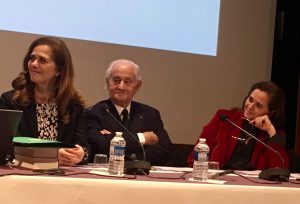
on March 7, 2019 for the first Ernest and Claire Heilbronn Prize ceremony at the Shoah Memorial; Hubert Heilbronn surrounded by his two daughters
His Judaism was not religious, far from it, it was spiritual, intellectual but above all made of fights for the dignity of the Jews in France, in Israel and in the whole world as had taught him so well the luminous pages of "Our youth" by Péguy, dedicated to Bernard Lazare. He often quoted this phrase of Péguy about the Jewish people, a sentence that he made his own: "I know this people well. He does not have on the skin a point that is not painful, where there is an old bruise, an old contusion, a dull pain, a scar, a bruising from the East or the West."
In 1952, he had gone to live for six months on kibbutzim in Israel. This country also became for him a "Land of love", for which he will always fight, until his last breath.
His last breath in the arms of his three children, when at the same time the criminal Iranian missiles were all shot down over the sky of Israel. He would have been worried and proud. He, who since October 7 and the massive pogrom of Jews in the land of Israel, like all the Jews of his generation experienced this return to anti-Semitic barbarism even more painfully. And as in the dark years, as a second wound, this murder of Jews was supported or even acclaimed by many French people and even deputies. Since October 7, some buried anxieties have resurfaced. My struggles sometimes worried him but also reassured him and, as always, he supported me, reread my texts before sending them to the press.
His support for Israel was constant, in 1956 serving as Maréchal des Logis in the French cavalry, he wanted to join the French paratroopers who were jumping on Suez to fight alongside the Israeli ally. In 1967, with his brother Didier, they volunteered at the Israeli Embassy to defend Israel against five Arab armies. In 1991, when Israel was under fire from potentially gas-laden Iraqi Scuds, he went there in solidarity with a CRIF delegation. He spent a night in a shelter with a gas mask where he exchanged quotes from Péguy with his friend François Léotard.
In 2002, in the midst of a wave of murderous attacks in Israel, he did not hesitate with my mother and I, like Simone Veil and her son Pierre-François, to go for Yom Hashoah to the kibbutz of the fighters of the Warsaw ghetto. Simone and Pierre-François lit one of six flames representing our six million dead, my father and I another. Finally, he often returned to Israel to participate in the conferences of Tel-Aviv University. University where he gave a series of courses within his French cultural department on "Five French writers – Pascal, Chateaubriand, Lamartine, Péguy, Claudel – in the mystery and light of Israel".
By marrying our mother Gina Escojido, with whom he will now rest and who has been missing him every day since her disappearance four and a half years ago, he married the sun of the Mediterranean. Our maternal family was Jewish from the Ottoman Empire and Egypt, expelled from their country in 1956, our grandparents, Jaïme and Soledad, our uncles and aunts settled in Israel. We met every summer at the Kibbutz of Sdot Yam near Caesarea. Papa came there with happiness and declaimed Bérénice in the ruins of Caesarea with his brother-in-law and friend Claude Sautet, and dedicated these verses to my sister Laurence, whose third name is: "I remained a long time wandering in Caesarea...".
This love of Israel, the pride of a French Jew rooted in his land of France, his generosity, courage and philanthropy led him to become an active activist in many Jewish associations.
At the request of his president Jules Braunschwig, a close friend of his father, he joined the Alliance Israélite universelle in 1975 until his death. Where he then assisted his friend Professor Ady Steg, who became its President. Then he agreed to join CRIF under the presidency of a man he admired, Alain de Rothschild, and he became treasurer under the presidencies of Alain, but also Théo Klein and Jean Kahn for almost 20 years. He was still a member of its Steering Committee.
In 1985, encouraged by our mother who raised funds with Mary de Rothschild to save the Memorial of the Unknown Jewish Martyr in great difficulty, which has since become the Shoah Memorial, he became its vice-president alongside Eric de Rothschild, whose friendly presence I would like to acknowledge today, as well as that of all the Memorial teams and its director Jacques Fredj.
At the Memorial, he was a driving force with Éric de Rothschild, Serge Klarsfeld, Simone Veil, André Wormser, Jacques Fredj and our beloved Pierrot Kauffmann for the extension of the Memorial and the creation of the Wall of the Names of Jews deported from France where the names of twelve of his own are engraved, that he has all known and loved. It was he who insisted that the Wall of the Just among the Nations be built in the same place, he who had been saved by an admirable couple, to whom he will remain as my faithful grandparents all their lives.
Having joined the Memorial office at his side in 2000, he wished like Éric that I become its vice-president in his place in 2008.
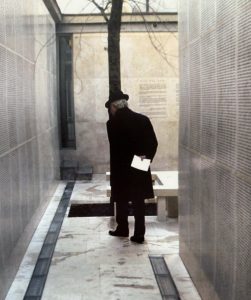
Hubert Heilbronn in front of the Wall of Names on January 25, 2005
It was in 2014 that he wanted to create a foundation housed at the Shoah Memorial, named after his beloved grandparents, Ernest and Claire Heilbronn, murdered at Auschwitz-Birkenau, to fund and reward doctoral students working on the history of Jews in France, professors committed to fighting racism and anti-Semitism and confirmed historians, and to publish a reference book on Jews in France published this year.
He presided over this Foundation until the end, and on March 12, a month ago, for the 80th anniversary of the deportation of Ernest, Claire, and Marcelle, his aunt, he presided over the award ceremony at the Memorial and read the letter that Ernest Heilbronn had sent to the prefect of Isère on 12 July 1941, where he wrote:
Mr. Prefect,
In order to comply with the law of last June 2nd, I have the honor to make the following statement.
My name is Ernest, Georges Heilbronn. I am an Israelite, born in Paris on October 13, 1867. I am French; my parents were French.
My wife, born Claire Marie Goldschmidt, who lives with me, was born in Paris on July 25, 1872; her parents were French. Our usual home is in Paris.
We are staying temporarily at the Modern Hotel.
Lives with us generally our grandson Philippe Pierre Heilbronn, born in Paris on July 25, 1932, whose father, our son Pierre Heilbronn, an officer in the 2nd French motorized cavalry group was killed at the enemy on June 9, 1940..."
Another of his deep commitments was the Judeo-Christian Friendship, for which he created the Prize in 1990, a prize that since then has borne his name, the Hubert Heilbronn Prize of the Jewish Friendship.Christian and which he awarded again last November This award was a way of honoring his aunt Marcelle Chevalier, born in Heilbronn, a heroic nurse from both wars, converted to Catholicism, who chose to voluntarily follow her parents into deportation so as not to abandon them. In this remarkable institution, he formed deep friendships with the chief rabbi Sirat and cardinals Lustiger and Decourtray. He fought with them to the end so that the sacrilegious Carmel of Auschwitz would be withdrawn.
Here is the life of a Jew in the city, a committed Jew, a fierce republican of a hidden Jewish child who, through the fight for justice, has shown himself worthy of all his ancestors, patriots, philanthropists, lovers of justice, enlightened and in love with the Republic and France.