The Maison d'Izieu, opened by Sabine and Miron Zlatin in Ain, welcomed more than a hundred Jewish children between 1943 and 1944.
Les enfants de la maison d'Izieu, 1943. Shoah Memorial / Coll. OSE
On the morning of 6 April 1944, the 44 children and seven educators who were there were rounded up and deported on the orders of Klaus Barbie, head of the Gestapo in Lyon. With the exception of two teenagers and Miron Zlatin, deported in convoy 73 to the Baltic countries and murdered at Reval (now Tallinn) in Estonia, the group was deported to Auschwitz-Birkenau. Only one adult, Léa Feldblum, survives. All the others were murdered upon arrival.
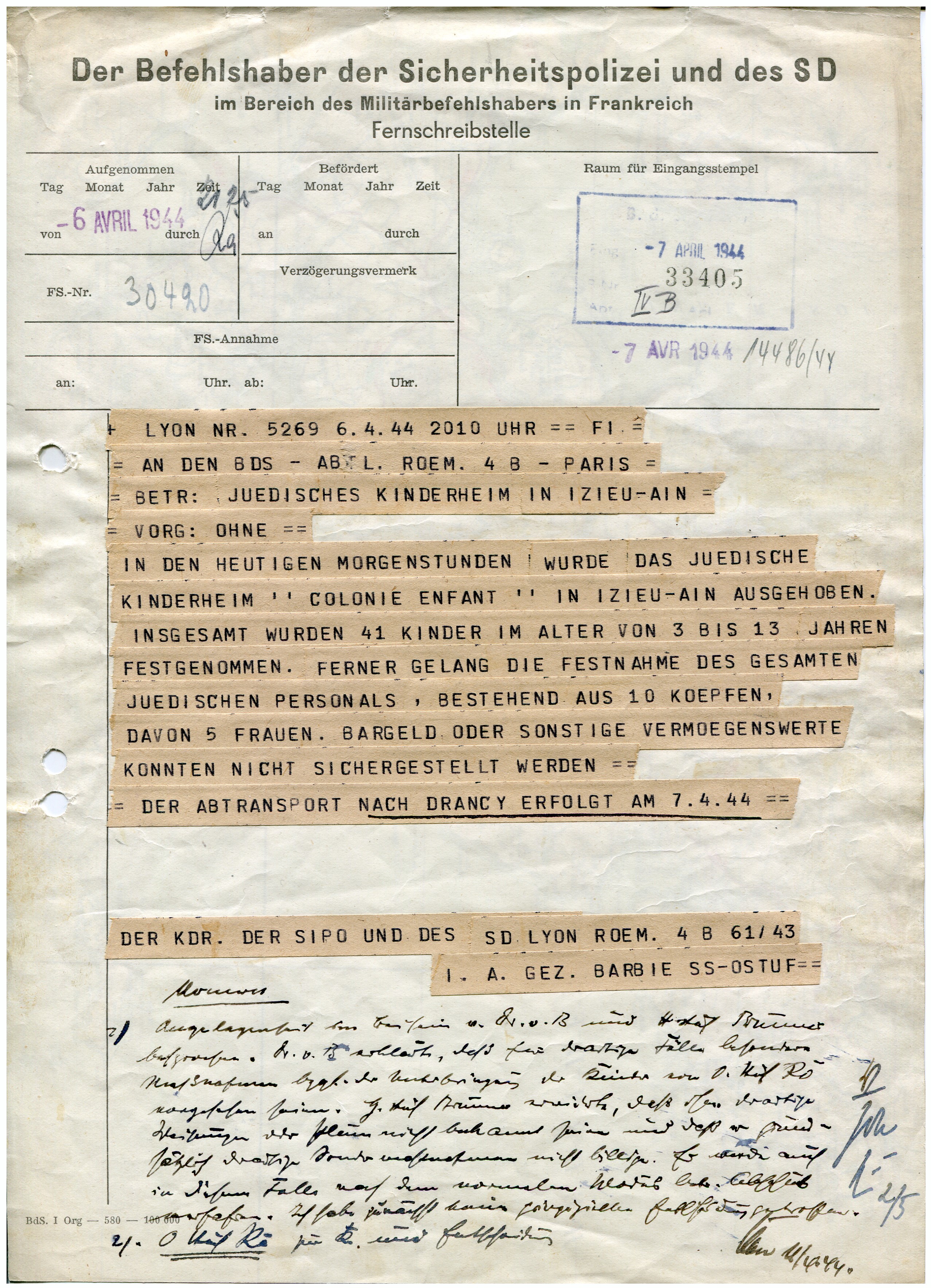
Hunted and brought back to France by Beate and Serge Klarsfeld, helped by Fortunée Benguigui and Ita-Rosa Halaunbrenner, mothers of children who were rounded up in Izieu, Klaus Barbie was presented before the French justice in 1987 in Lyon. During the investigation, Serge Klarsfeld found in the archives of the Center for Contemporary Jewish Documentation (CDJC), Barbie’s telex reporting the deportation of forty-four children.
Karen Taieb, head of archives at the Shoah Memorial, explains to us in a video what the Izieu telex is:
This document is one of the main pieces of evidence that will make it possible to convict Klaus Barbie for crimes against humanity:
This trial definitively anchors the Izieu roundup in the French memorial landscape.
In the aftermath of this trial, in March 1988 around Sabine Zlatin was formed the association "Musée-Mémorial des enfants d'Izieu". A place of memory, education and life, the Memorial of the House of Izieu was inaugurated in 1994 by the President of the Republic François Mitterrand, in the presence of Sabine Zlatin, who was not at Izieu on the day of the roundup.
Les enfants de la maison d'Izieu, 1943. Shoah Memorial / Coll. OSE