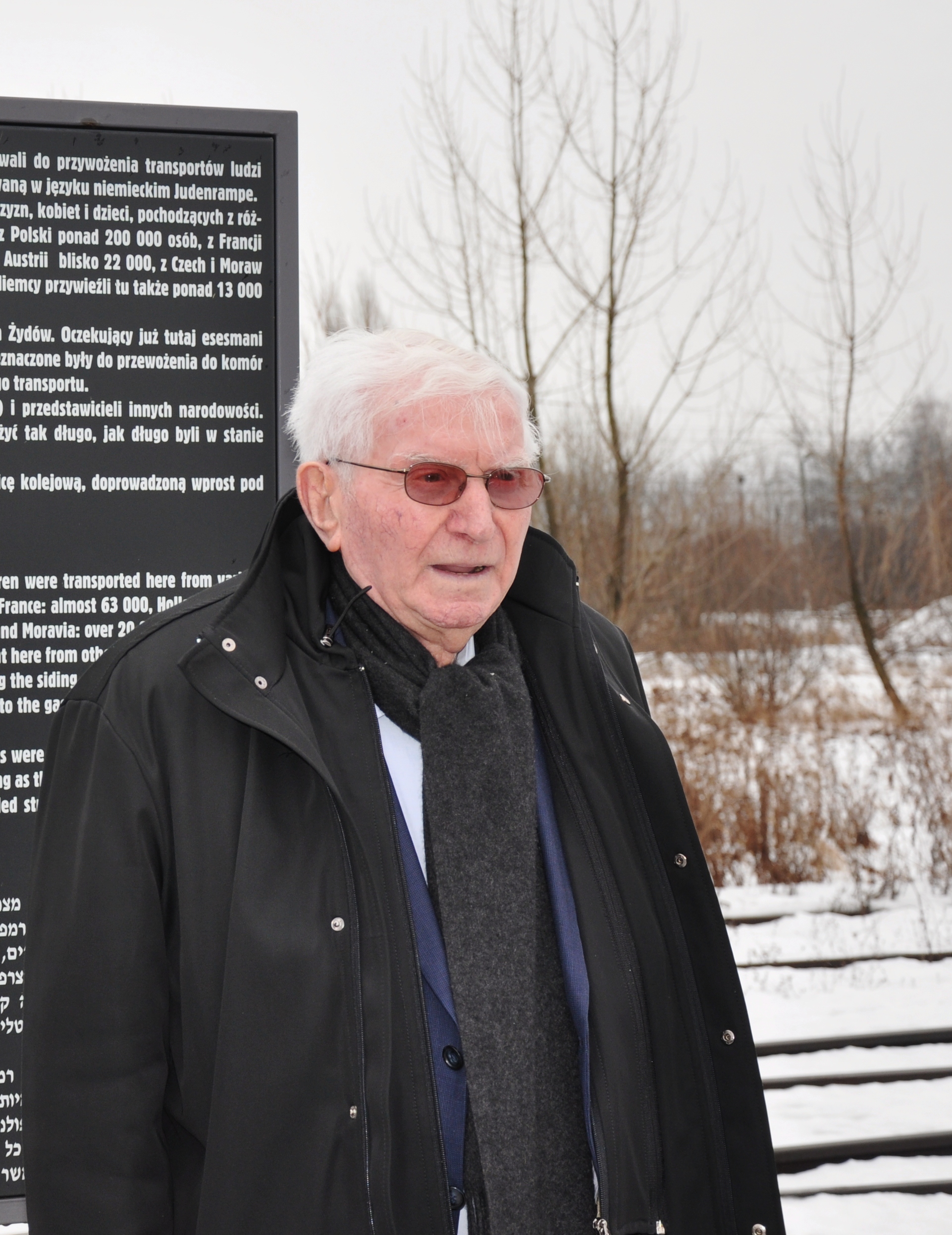
the Memorial greets the memory of Benjamin Orenstein who died on February 10, 2021
Credit: photo taken during a trip to Auschwitz that the Memorial organized in 2013, © Shoah Memorial
Benjamin Orenstein, a survivor of the Auschwitz-Birkenau camp and honorary president of the Amicale des Anciens Déportés d'Auschwitz-Birkenau et des camps de Haute-Silésie du Rhône, died on Wednesday, February 10, 2021.
Benjamin Orenstein was born on 15 September 1926 in the city of Annopol, Poland, the youngest of five children. His parents live from the trade of eggs and veal.
In 1941, it was forbidden for Jews to move more than a kilometer from the center of Annopol. Men are employed in German companies located on the outskirts of the city. When he was not yet fifteen years old, Benjamin Orenstein took the place of his father who had been arrested and sent to the Ieniszow labor camp. He manages to escape after five weeks, joins his family and goes to work on a farm.
On 13 October 1942, the Jews of Annopol were deported to the killing center of Belzec, except for a group of about 100 men, including Benjamin and his three brothers, who were taken to the camp of Rachow to carry out agricultural work. In 1943 he was transferred to Budzyn, where he worked in an aviation factory. In November, he learned that all of Rachow’s prisoners, including his three brothers, had been executed.
In May 1944, as the Soviet troops approached, the detainees from Budzyn were sent to Ostrowiec camp and then to Auschwitz camp where Benjamin arrived on 4 August. He is registered and tattooed with the number B 4416. He was transferred to Fürstengrube, a satellite camp of Auschwitz III, where he worked in a coal mine until 13 January 1945. After the "death march", he failed at the camp in Dora, where he fell seriously ill. He was finally released by the U.S. Army on 11 April 1945.
Benjamin Orenstein was then 18 and a half years old. He no longer had any family, weighs 32 kilos. After a period of convalescence in a center of the Jewish Agency in Trévano, Switzerland, he managed to reach Palestine and spent some months at the kibbutz of Aloumot, in the Jordan Valley. He joined the army when the State of Israel was created in May 1948 and participated in the first Israeli-Arab conflict. Demobilized in 1950, he joined a cousin who lived in France and settled permanently in Lyon in November 1951.
Following the trial of Klaus Barbie in Lyon in 1987, he decided to testify and committed himself with determination to the transmission of the memory of the Shoah, in France but also by accompanying study trips on the site of the Auschwitz-Birkenau camp. Benjamin Orenstein chaired the Amicale des Anciens Déportés d'Auschwitz-Birkenau and the camps in Upper Silesia of the Rhone for many years. The newspaper Le Monde dedicated a portrait to him on May 8, 2020. Benjamin had published his testimony in 2006, Ces mots pour sépulture (These words for burial).
Benjamin Orenstein was made a knight of the Legion of Honor in 2015 and a commander of the Palmes académiques in 2018.
The Shoah Memorial salutes the memory of this ardent activist and offers its sincere condolences to his children and grandchildren.