The youth of Modena facing European history. The International Memorial
On June 3, at the IPSIA Institute "Fermo Corni" in Modena, students from VA and VB classes presented the final results of the educational project "Memories on the Move: Borders, Migrations, and Identity in Post-World War II Europe", carried out as part of the teacher training program Holocaust as a Starting Point.
Under the direction of their professor of letters, Federica Di Padova, the students conducted an important research work devoted to forced migrations in 20th century Europe, with particular attention to the Adriatic border region and the exodus of Istrian, Julian and Dalmatian populations from Yugoslavia to Italy in the postwar period.
The project was based on the methodological approach proposed by the Paris Shoah Memorial, based on the comparison of different national narratives related to the eastern border: the Italian, Slovenian and Croatian perspectives. This method allowed students to confront the complexity of history, by going beyond simplified readings and valuing the confrontation of different points of view.
After a phase of historical research, the classes created a website and a series of podcasts that provide an in-depth look at the context of the Second World War, the persecution of European Jews, the forced displacement of populations and the consequences of these events in the post-war period, thus helping to shape the history and memory of the European continent.
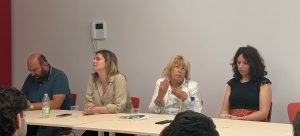
The presentation took place in the presence of Daniele Susini, correspondent for the Shoah Memorial for Italy, Federica Venturelli, assistant for Education and Relations with the University of the City of Modena, as well as Maria Costi, president of the Youth Commission, School, Training, Culture, Communication and Work of the Legislative Assembly of the Emilia-Romagna Region.
This initiative was an important opportunity to reflect on the link between memory and community. Studying past events does not only mean acquiring knowledge of distant historical facts, but also understanding how experiences of persecution, war, exile and reception continue to question our present. From this perspective, memory becomes a true tool of citizenship, capable of strengthening the sense of belonging to a democratic community and fostering dialogue between histories, identities and generations.