Route of the exhibition
Shoah by Claude Lanzmann, the unreleased recordings
Discover the journey around the audios of the exhibition Shoah by Claude Lanzmann, the unreleased recordings
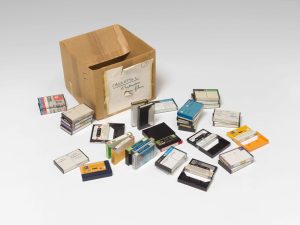
Photography: Audio cassettes from the Lanzmann collection; Jewish Museum in Berlin, photo: Roman März.
Part One– "This is a Holocaust inquiry."
Searches
In these recordings, Claude Lanzmann explains his film project while answering the questions of his interlocutors. He discusses his methods and perspectives, but also the psychological challenges encountered, personal motivations or financial and organizational conditions.
PART TWO – “You can stay perfectly silent in front of the camera.”
Inaudible voices.
Some of the interviewees do not wish to speak in front of the camera. Here are three people that Claude Lanzmann failed to convince to participate in the filming. Ilana Safran, who recounts her deportation from the Netherlands to Sobibor (Poland), her arrival at the extermination camp and the revolt of the prisoners. She also describes how, in the mid-1960s, when called to testify at the Sobibor trial, she had to identify the culprits.
The entrepreneur Hermann Gräbe describes under what circumstances he witnessed massacres committed by the Nazis in occupied Ukraine and how he managed to protect hundreds of forced laborers from the Nazis. To do this, he was helped in this task by Maria Bobrow, herself a forced worker employed at his company.
THIRD PART – "I can’t talk about the ghetto."
The Holocaust in Lithuania
From the beginning of his research, Claude Lanzmann had a particular interest in the massacre of Lithuanian Jews. The audio recordings retrace the chronology of the deadly events that took place under the German occupation since the summer of 1941. Eyewitnesses tell of pogroms carried out by the local population. They talk about the massacres committed by a mobile killing unit (SS Einsatzkommando) in Fort 9 of Kaunas and in the forest of Ponary, near Vilnius: during the first half of 1941, these units murdered three-quarters of the Jewish population. In their stories, the survivors also try to find words to describe life in the ghettos of Kaunas, Šiauliai and Vilnius. The film will finally address very little of this subject.
Part 4– "No, it’s over for me!"
Criminals
Claude Lanzmann understood very early that he also wanted to question the criminals for his film. This is how he sought in Germany high-ranking officials, those who implemented the genocide, but also bureaucrats, profiteers, those who testified in the post-war trials. The director and his collaborators visit criminals at their homes without telling them. In many cases, the conversation stops at the door. When they are received, they hide the recorder at the bottom of a pocket. Criminals, when they agree to speak out, get entangled in justifications, seek to protect themselves with self-centered claims, distort the reality of their involvement and deny their guilt.
Part 5– "It was a macabre march."
First trip to Poland
The first trip to Poland was crucial for Claude Lanzmann in his approach to the genocide of Jews and Jews in Europe. Indeed, to make this trip, he will wait until he has arrived at the end of his research. When, at the beginning of 1978, he went to the places of persecution and extermination, he was imbued with knowledge acquired in books, archives and through countless interviews. The presence of history, which he is confronted with in Poland, strikes him with an unexpected force. The sound recordings made on site document not only the conversations with witnesses, but also the impressions felt by Lanzmann during his visits to the premises. The same year, Claude Lanzmann returned to Poland and began filming Shoah.
Sixth Part– "This cannot be done painlessly."
Sound and image
Only a few people appear at the same time in the audio recordings, in the film Shoah and in the important filmed material of the film: Jan Piwoński, whose interview sequences at Sobibór station play an important role in Shoah. Leon Kantarowski, who appears briefly in a scene before the church of Chełmno where he was organist. Tadeusz Pankiewicz, the non-Jewish pharmacist in the Kraków ghetto, whose video recordings were not used for Shoah. As well as Hillel Kook, who in his interview, present only in the audio archives, reproaches the American government for not having committed itself to the rescue of the Jews and Jewesses of Europe.
Insights and Perspectives
The audio recordings reflect only part of the many years' work that preceded the film Shoah. Conversations conducted as part of this research were not always recorded. The private archives of Claude Lanzmann contain letters, lists, notes and files dating from this period of research, which give an additional insight into the practical work of the director and his collaborators.
For an in-depth approach to the Lanzmann collection held at the Jewish Museum in Berlin, the exhibition interviews are transcribed in their entirety, translated and contextualized by the museum. This digital edition is being continuously enriched and will be fully available by the end of 2027 on the online platform Oral-History.Digital (OH.D). Access requires prior registration.
Return to the exhibition