Yom HaShoah 2026: Passing on history at the Shoah Memorial in Paris
On the occasion of Yom HaShoah, the day of remembrance for the victims of the Shoah and the Jewish resistance, the Shoah Memorial in Paris offers a special program.
Between graphic narratives, contemporary literature and cinema, these three events invite to explore new forms of transmission so that memory remains alive and accessible to all generations.
Graphic narratives and memory of the Shoah: the stakes of transmission
Monday, April 13, 2026, at 9 p.m.
Meeting
At a time when the last witnesses are disappearing, comics and graphic novels have an increasing place in the transmission of the memory of the Shoah. How did graphic design become a central relay for memorial transmission? How to reach a younger audience while preserving historical rigor? Around a panel composed of cartoonists and historians, this meeting questions the aesthetic, ethical and pedagogical issues of graphic narrative.
Opening by Charles Tenenbaum, EEIF.
In the presence of Jérémie Dres, Les Fantômes de la rue Freta (Bayard, 2025), Boris Golzio, Lili toujours debout jusqu'au bout (with Lili Leignel, Glénat, 2026) and Pierre‐Roland Saint‐Dizier, La Maison des enfants: l'incroyable sauvetage des enfants juifs de Moissac (Plein Vent, 2025).
Moderated by Mathias Orjekh, coordinator of the study tours, Shoah Memorial, and Léa Taieb, journalist in Tenoua.
Proposed with the Éclaireuses et Éclaireurs israélites de France and other youth movements.
Free, Upon registration
Sophie Brafman’s “Children of Yesterday and Today”
Tuesday, April 14, 2026 at 2:30 p.m.
 Projection
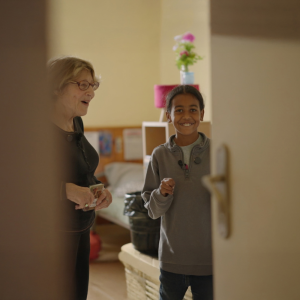
Innayah & Suzanne / Shyna & Lucette / Naël & Bernard / Antoine & Georges.
France, documentary series of 4 episodes, 4 x 6 min, production Brave Girl Biper Ad (c) Fondation Opej, 2025.
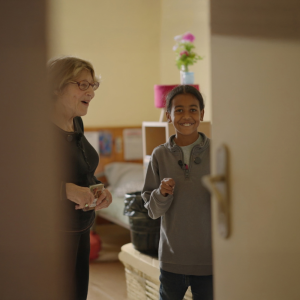
What is the link between Suzanne Avner, 89 years old, a Polish Jew born in Paris and Innayah, 12 years old, a Muslim of Moroccan origin born in France? At 80 years interval, they will grow up in the same place, the Children’s House of Opej (Work of protection of Jewish children) in Rueil-Malmaison. Four films present four pairs of children and elders, each revealing a unique and deeply human encounter. At the turn of a few words, the conversation starts, the elders tell their memories of a childhood damaged in the Shoah, the youngest entrust them with their own journey and their dreams for the future.
In the presence of Katy Hazan, historian and director of the Archives and History department at the OSE, Bernard Goldberg, survivor of the Shoah, former resident of the Opej, and Shyna, current resident of the Opej.
Hosted by Sophie Brafman, journalist and director.
With the support of the Foundation for the Memory of the Shoah.
With the support of the United Jewish Social Fund and the association Les anciens de l'Opej.
Free, registration required
Marc Grandsard’s "Visit"
Tuesday, April 14, 2026 at 4:30 p.m.
 Projection
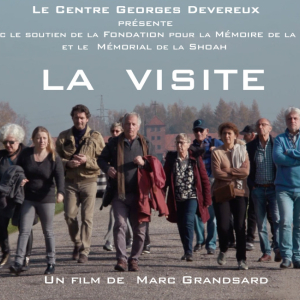
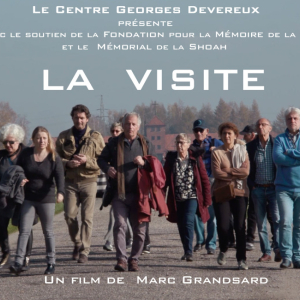
France, documentary, 59 min, production Centre Georges Devereux, with the support of the Mémorial de la Shoah, 2019.
They are about ten former hidden children, most of them orphans from the Shoah, born between 1935 and 1943 in France. Their parents, their grandparents, mostly emigrants from Poland, were deported to Auschwitz and Sobibor. They were saved by the skin of their teeth, hidden among non-Jewish French people. They had never dared to make the trip, but since they participated in the monthly meetings of the group of former hidden children, led by psychologists, at the Shoah Memorial, they wanted to visit the Auschwitz camp.
In the presence of the director, Chief Rabbi Olivier Kaufmann, Olivier Lalieu, historian, responsible for places of memory and spatial planning at the Shoah Memorial, and Nathalie Zajde, lecturer in psychology at the University of Paris 8 Vincennes Saint-Denis.
Led by Alexandre Doulut, historian and trainer at the Shoah Memorial.
Free, upon registration